Saturday, April 6, 2013

Who (or What) is an Evangelical? - Part 2

At the root of the word "evangelical," is good news, glad tidings, or a good message.

The New Testament Greek word, εαγγέλιον, (transliterated euangelion (eu- "good", -angelion "message.") In English, we get the word gospel from this, since the Old English word, gōd-spell, means the same thing.

Four Evangelist - Irish Book of Krells
This is why Christians refer to the four authors of the gospels as the Four Evangelists.  At a very basic, simple level, an evangelical is one who proclaims and lives by the good news - the gospel of Jesus Christ.  At this simple and basic level, Evangelicals claim an ongoing tradition back to Jesus Christ, the Four Evangelists, and the Apostles.

Yet, if this was all Evangelical meant, then all Christians would be Evangelicals, so I further explore what the word Evangelicals has meant over time.  However, I wish for now to emphasize that in this sense Evangelicals wish to identify, or stand, with all Christians over time.

Back to Part 1
On to Part 3

Thursday, April 4, 2013

Who (or What) is an Evangelical? - Part 1

I was at a small group meeting of Christian men.  I read an excerpt from a statement by Evangelicals and Catholics Together.  We were discussing it when someone (Grant Steer) asked me, what is an Evangelical?  I did my best to give an on the spot answer.  However, I wanted to deal with that question more fully in this blog.  This part will speak to some of the difficulties about such an answer.

Evangelicals often get discussed without clarifying who or what they are.  This can get confusing at times since many
counterpoise Evangelicals and Catholics, and yet there are Evangelical Catholics.  Meanwhile, many equate Evangelicals with Protestants, and yet there are many Protestants who are not Evangelicals.  Yet, at the same time, Evangelicals can be found in all Protestant denominations and many non-denominational associations and independent churches.  Evangelicals can also be found in Eastern Orthodoxy, and other branches of Christianity.


To compound the problem, there is no unifying definition of Evangelicals, and no uniform statement of beliefs or even agreed upon collection of features or characteristics, though there are common features and characteristics.  There is no agreed upon leader or office of leadership, though various organizations represent member Evangelicals.

In addition, there is no agreed time period for the Evangelical movement, nor even an agreed upon time when it began, though there is a definite history of the Evangelical movement that can be studied.

With this in mind, I will try my best to explain in the next few parts - who (or what) is an Evangelical?

On to Part 2

Monday, April 1, 2013

Pope Francis

Pope Francis
The new Pope Francis (Cardinal Bergoglio) has made many important symbolic gestures in his first days which shows his humility.  He began by asking for prayers.  Recently, instead of washing the feet of 12 priests on Holy (Maundy) Thursday, he went to a juvenile detention center and washed the feet of inmates there, some of them not Catholics, some of them Muslims, but even more of a break with tradition, two of them were women.  That may not seem much, but Catholic custom has held that since Jesus washed the feet of his 12 disciples at the Last Supper, and since they were all men, the Pope should only wash the feet of men on Holy Thursday.  By this simple break with that custom, Pope Francis indicated not only that he wanted maintain a certain amount of freedom in his actions, but that he sincerely understood that the main thrust of this act by Jesus was to say he was a servant, which Pope Francis wants to identify with.

Pope Francis addresses the Curia in Clementine Hall (Vatican)
However, on a more important note, Pope Francis has broken with another important Vatican custom.  When a new pope is elected, all the Vatican department heads (who run the Curia), technically lose their jobs (much as the department heads in the United States lose their jobs when a new President is elected).  (The Curia is the Vatican bureaucracy.)  By custom, the new Pope simply reconfirms all the department heads already in office.  In a break from this custom, Pope Francis did not reconfirm those department heads.  Instead, he asked them to continue in their jobs "until other provisions are made."  He said he needed time to reflect, to pray, and to consult with others.  Many Vatican observers think this indicates Pope Francis will engage in a shake-up of the Curia, which many say is sorely needed.  We will see.  However, if Pope Francis simply wanted to keep thing the way they were, he would have simply reconfirmed all the Vatican (Curia) department heads as his predecessors had done.

Some articles about this major development, which most of the major media outlets seemed to miss.
http://ncronline.org/blogs/ncr-today/francis-drops-first-hint-reform-may-be-real
http://www.catholicherald.co.uk/news/2012/12/21/full-text-of-popes-address-to-the-curia/


Sunday, March 31, 2013

Raising Of The Cross - Rembrandt

The Raising of the Cross - Rembrandt - 1633
In 1633, Rembrandt (Harmenszoon van Rijn) completed painting "The Raising of the Cross."  (Displayed at left.) Though other painters had depicted this scene, this was the first where the artist portrayed himself in the scene - you can see him in the center of the scene with the beret cap.

While some art critics commented that Remrandt inserted himself at a vain effort to display piety, or simply to vaingloriously insert himself in a major work of art, I (and other art scholars) tend to believe that Rembrandt, a devoted Christian, though an imperfect man, meant to show that he understood that his sins drove Christ to the Cross - and meant to show this understanding to the world.

I find this painting inspiring - especially during Lent.  Often we find ourselves in the middle of a debate - did the Jews crucify Jesus - or did the Romans (through Pontius Pilate).  The truth as conveyed in the New Testament is our sins drove Jesus to the Cross, as the New Testament affirms in several passages- or perhaps more accurately - Jesus Christ submitted himself to the Cross in order to take our place for the punishment we deserved for the sins we committed, in the supreme ultimate act of love.  This is the heart of the gospel (good news) message.

Tuesday, February 12, 2013

What Is Lent (Anyway)? - Part 5

Lent is not a time to do something you would not do at other times of the year.  Instead, it is a time to focus on certain activities with renewed vigor in commemoration (remembrance) of the 40 days Jesus spent in the desert.

In Church tradition, Christians take up three practices during Lent - and they all relate to justice.  The first practice is prayer, which relates to justice towards God.  The second practice is fasting, which relates to justice to one's self.  The third practice is almsgiving (giving to those in need), which relates to justice to our neighbors.

The fasting does not necessarily have to be food.  It could be anything at all that tends to distract us from our focus on God and spiritual matters.  For those who choose a food fast, it could be a fast from certain kinds of foods or beverages.  It could be a fast from in between meal snacks, or from a meal each day.  Some fast from sunrise to sunset.  For those who give up something, they sometimes give the money they would have otherwise spent to the needy.

The point here is there is a whole range of options and freedom of what to do during Lent.  However, if you give up something, it should be something that helps you to focus on God and spiritual matters, not something  that turns your focus on what you have given up.

Another way to think about Lent is identifying with the suffering of Christ, which Philippians 3 encourages us to do.  As you remember that Christ gave up eating for 40 days for our sake, you can ask yourself what am I willing to give up for 40 days to identify with that and to help me remember what He did.  It can help you better understand this episode in the life of Christ.

Lent is a rich tradition to draw from in the Church - and I hope and pray you can grow in Christ and be renewed during it.

Back to Part 4.
Start at Part 1.

Monday, February 11, 2013

What Is Lent (Anyway)? - Part 4

Since Lent commemorates Jesus fasting in the desert for 40 days, it leaves us with the question, why did Jesus do this?  Matthew (4) tells us that immediately following His baptism, the Spirit led Jesus into the wilderness to be tempted by the devil.  Before starting his public ministry, Jesus went to face a spiritual battle with our great adversary, Satan – a sort of clash of the titans.  (The wilderness location hearkens back to the 40 years Israel spent in the wilderness being prepared to enter the promised land.)

Often in Scripture, in both the Old and New Testaments, in critical moments, often in the midst of spiritual warfare, men of God, the people of God, and sometimes even pagans, fast to overcome their enemies, to avert judgment, or to bring about God’s will.  Fasting can help clear the mind to better focus on spiritual matters.

Matthew tells us the devil came to Jesus on the last day of the fast, when Jesus was hungry.  Perhaps Lucifer thought Jesus was at his weakest.  However, Jesus was strong and resisted each temptation presented.  While Matthew simply says the devil left Him, Luke records the devil left Him until an opportune time, meaning Satan would return another day.  Upon overcoming this initial battle, Jesus then entered into his public ministry.

Go to Part 5
Go back to Part 3.

Saturday, February 9, 2013

What Is Lent (anyway)? - Part 3

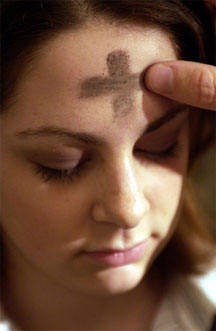
The first practice most Christian traditions observe during lent is Ash Wednesday, where a priest or minister marks the forehead of the participant with black ashes in the sign of the cross.  The worshiper traditionally retains the mark until it wears off.  Ash Wednesday marks the start of Lent in most Christian traditions.  (For example, the Eastern Orthodox tradition starts Lent on Clean Monday.)  While applying the ash mark, the priest or minister usually quote a portion of Genesis 3:19 - Remember that dust thou art, and to dust thou shalt return.  (KJV) (Some quote Mark 1:15 - Turn away from sin, and be faithful to God.)

In Church tradition, Ash Wednesday is a day of repentance.  Ashes appear several times in the Bible as sign of mourning over sin.  Some passages combine sackcloth and ashes, while others combine dust and ashes, all as ways of expressing sorrow over sin.  So most traditions focus on repentance of sins on Ash Wednesday.  Some Christian traditions observe fasting or abstinence from meat on Ash Wednesday, while other traditions make this optional.  Psalm 51 is often read on Ash Wednesday and the mass or service often calls for the corporate confession of sin.  In some traditions, small cards are handed out where people are invited to write their sins.  The cards are then brought up front, where they are burned.

Go to Part 4
Back to Part 2

Friday, February 8, 2013

What Is Lent (anyway)? - Part 2

Most people associate Lent with 40 days, even though from Ash Wednesday to the Saturday before  Easter actually takes 46 days.  However, in most Western traditions, the six Sundays during this period of time are not counted as part of Lent, so that the 46 days then results to 40 days.  In Church tradition, each of the Sundays represent a mini-Easter, and so are not counted as part of Lent.  (Since some traditions consider Holy Thursday, or Maudy Thursday, as the end of Lent - those traditions technically have 38 days of Lent if you exclude the Sundays, or 44 days if you include them, though they still emphasize 40 days of observing Lent.)  (Other Christian traditions start Lent on a different day than Ash Wednesday, and exclude or include different days, but they all focus on observing 40 days of Lent.)

However, this raises the question, why 40 days?  Church tradition identifies the 40 days of Lent as a commemoration of the 40 days our Lord spent in the desert fasting and facing temptation from Satan before the start of his public ministry, as recorded in the gospels of Matthew, Mark, and Luke.  40 days is a significant number in Scripture from other events - rain fell on the earth for 40 days and nights in Genesis 7; Moses spent 40 days with God on Mount Sanai in Exodus 24 (fasting); Elijah spent 40 days and nights walking to Mount Horeb (the old name for Mount Sanai) in 1 Kings 19; Jonah gave the people of Ninevah 40 days to repent or be destroyed by God in Jonah 3; though much longer - the children of Israel spent 40 years wandering in the desert in their travel to the Promised Land in Numbers 14.  There is something special about the number 40 in the Bible.

In the next part, I will discuss how Christians in Church tradition have commemorated the 40 days Jesus spent in the desert fasting and facing temptation.
Go to Part 3
Back to Part 1


Thursday, February 7, 2013

What is Lent (anyway)? - Part 1

Lent - Springtime
Lent is a Middle/Old English word that means Springtime, or simply Spring.  It derives from a German word for Spring - which itself derives from a German word for long - since as Spring approaches, the days get longer.
In Latin (the early language of the Church - besides Greek), Lent was called "qudragesima," which basically means forty.  So, in many languages, lent is called by some derivation of forty.  For example, in Spanish, it is called cuaresma, which roughly means forty (cuarenta).
In some languages (usually Slavic languages), Lent is called by a name which refers to fasting.  So in Russian it is called vyeliki post (great fast) or in Czech postní doba (fasting time).
I will have more to say about why it is often called forty in many languages in my next post.  Go to Part 2

Sunday, January 20, 2013

Sholem Aleichem

I recently have been reading and enjoying some short stories by Sholem Aleichem - after watching the DVD of Fiddler On The Roof (which mentioned them).

Sholem Aleichem was the pen name for Solomon Naumovich Rabinovich, who lived from 1859-1916 (57 years).  Though he grew up in Russia, he resettled in New York in 1905 after a pogrom (a violent mob attack against Jews) in his home country.

His pen neam is based on the traditional Hebrew greeting - sholem aleichem. which means "peace be upon you."  The traditional Hebrew response is Aleichem shalom - which means "upon you be peace."

He became a central figure in Yiddish literature,  (Yiddish is a Jewish type of German spoken by many Jews in central and eastern Europe.)  He not only extensively wrote in Yiddish - he used his personal fortune to encourage other Yiddish writers.

He became known as the "Jewish Mark Twain."  (When Mark Twain heard about this - he said, "Please let him know I am the American Sholem Aleichem.}

Many of his writings revolved around the shtetl (small towns in central and eastern Europe with large Jewish populations) and the many unique characters found there.  Since Shalom Aleichem grew up in a shtetl - he was very familiar with those characters.  One of the characters he wrote about was Tevye - in a collection of stories found in two books - one called Tevye The Dairyman and another called Tevye's Daughters.

These collection of short stories became the foundation for the Broadway musical called "Fiddler On The Roof" (with music by Jerry Bock - lyrics by Sheldon Harnick - and book by Joseph Stein.

His stories were noted for the naturalness of the character's speech as well as the accuracy of the description of shtetl live.  Also, many saw the cheerfulness of of the characters as a natural way of coping with adversity - though later - many saw a tragic side to his writings.

When he died - his funeral turned out to be one of the largest one's in New York City history.